

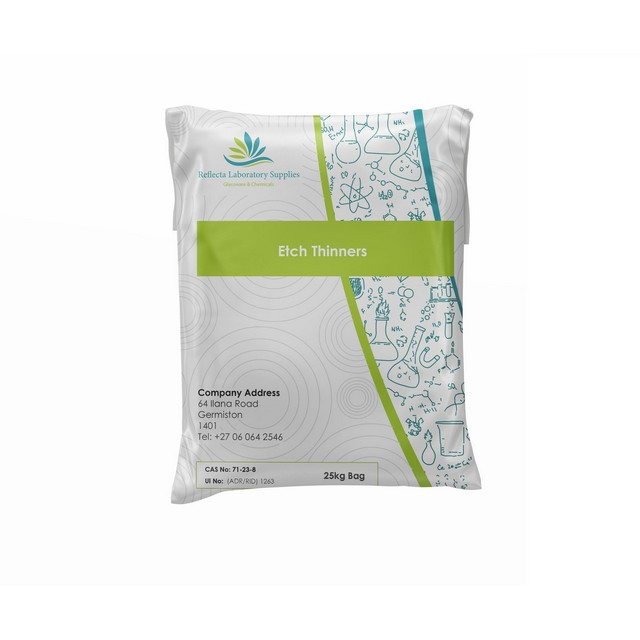
Etch Thinners
R236,00
1.1. Product identifier
Etch Thinners – Standard Product name ACTIVATED THINNERS FOR ETCH PRIMER
Product number GET010, GET050, GET000, GET999
1.2. Relevant identified uses of the substance or mixture and uses advised against
Identified uses Catalyst. Additive for paint.
1.3. Details of the supplier of the safety data sheet
REFLECTA LAB
SECTION 1: Identification of the substance/mixture and of the company/undertaking
1.1. Product identifier
Etch Thinners – Standard Product name ACTIVATED THINNERS FOR ETCH PRIMER
Product number GET010, GET050, GET000, GET999
1.2. Relevant identified uses of the substance or mixture and uses advised against
Identified uses Catalyst. Additive for paint.
1.3. Details of the supplier of the safety data sheet
REFLECTA LAB
Supplier
SUPPLIES
SECTION 2: Etch Thinners – Standard – Hazards identification
2.1. Classification of the substance or mixture
Classification (EC 1272/2008)
Physical hazards Flam. Liq. 2 – H225
Health hazards Skin Irrit. 2 – H315 Eye Dam. 1 – H318 STOT SE 3 – H336 Environmental hazards Not Classified
2.2. Label elements
Pictogram
Signal word Danger
1/9
ACTIVATED THINNERS FOR ETCH PRIMER
Hazard statements H225 Highly flammable liquid and vapour.
H315 Causes skin irritation.
H318 Causes serious eye damage.
H336 May cause drowsiness or dizziness.
Precautionary statements P101 If medical advice is needed, have product container or label at hand. P102 Keep out of reach of children.
P210 Keep away from heat, hot surfaces, sparks, open flames and other ignition sources. No
smoking.
P261 Avoid breathing vapour/spray.
P271 Use only outdoors or in a well-ventilated area.
P280 Wear protective gloves, eye and face protection.
P305+P351+P338 IF IN EYES: Rinse cautiously with water for several minutes. Remove
contact lenses, if present and easy to do. Continue rinsing.
P310 Immediately call a POISON CENTER/ doctor.
P403+P233 Store in a well-ventilated place. Keep container tightly closed.
P405 Store locked up.
P501 Dispose of contents/ container in accordance with local regulations.
P101 If medical advice is needed, have product container or label at hand.
P102 Keep out of reach of children.
Contains PROPAN-1-OL, ISO-BUTANOL, PHOSPHORIC ACID …%
2.3. Other hazards
SECTION 3: Composition/information on ingredients
3.2. Mixtures
PROPAN-1-OL 60-100% CAS number: 71-23-8 EC number: 200-746-9
Classification
Flam. Liq. 2 – H225
Eye Dam. 1 – H318
STOT SE 3 – H336
ISO-BUTANOL 10-<30%
CAS number: 78-83-1 EC number: 201-148-0 REACH registration number: 01- 2119484609-23-0000
Classification
Flam. Liq. 3 – H226
Skin Irrit. 2 – H315
Eye Dam. 1 – H318
STOT SE 3 – H335, H336
PHOSPHORIC ACID 100% 1-<2.5% CAS number: 7664-38-2 EC number: 231-633-2
Classification
Skin Corr. 1B – H314
Eye Dam. 1 – H318
The full text for all hazard statements is displayed in Section 16.
2/9
ACTIVATED THINNERS FOR ETCH PRIMER
SECTION 4: Etch Thinners – Standard – First aid measures
4.1. Description of first aid measures
General information Remove affected person from source of contamination. Effects may be delayed. Keep affected person under observation. Get medical attention. CAUTION! First aid personnel
must be aware of own risk during rescue! Move affected person to fresh air at once. Keep
affected person away from heat, sparks and flames. If breathing stops, provide artificial
respiration. Place unconscious person on the side in the recovery position and ensure
breathing can take place.
Inhalation Remove affected person from source of contamination. Move affected person to fresh air and keep warm and at rest in a position comfortable for breathing. Keep affected person under
observation. Get medical attention. Show this Safety Data Sheet to the medical personnel.
Place unconscious person on their side in the recovery position and ensure breathing can
take place. If breathing stops, provide artificial respiration.
Ingestion Get medical attention immediately. Rinse mouth thoroughly with water. Give plenty of water to drink. Give milk instead of water if readily available. Keep affected person under observation.
Do not induce vomiting. If vomiting occurs, the head should be kept low so that vomit does not
enter the lungs. Get medical attention immediately. Show this Safety Data Sheet to the
medical personnel. Never give anything by mouth to an unconscious person. Keep affected
person away from heat, sparks and flames. Place unconscious person on their side in the
recovery position and ensure breathing can take place.
Skin contact Remove contaminated clothing immediately and wash skin with soap and water. Rinse with water. Use suitable lotion to moisturise skin. Get medical attention promptly if symptoms occur
after washing.
Eye contact Rinse immediately with plenty of water. Remove any contact lenses and open eyelids wide apart. Continue to rinse for at least 15 minutes. Do not rub eye. Get medical attention if any
discomfort continues.
4.2. Most important symptoms and effects, both acute and delayed
General information The severity of the symptoms described will vary dependent on the concentration and the length of exposure. Effects may be delayed. Keep affected person under observation.
Inhalation In case of overexposure, organic solvents may depress the central nervous system causing dizziness and intoxication, and at very high concentrations unconsciousness and death.
Vapours may cause headache, fatigue, dizziness and nausea. Vapours in high concentrations
are anaesthetic. Symptoms following overexposure may include the following: Headache.
Fatigue. Dizziness. Central nervous system depression.
Ingestion May cause discomfort if swallowed. May cause stomach pain or vomiting. May cause nausea, headache, dizziness and intoxication. May cause chemical burns in mouth and throat. Central
nervous system depression. Fumes from the stomach contents may be inhaled, resulting in
the same symptoms as inhalation.
Skin contact Prolonged contact may cause redness, irritation and dry skin.
Eye contact Irritation, burning, lachrymation, blurred vision after liquid splash. 4.3. Indication of any immediate medical attention and special treatment needed
Notes for the doctor No specific recommendations. If in doubt, get medical attention promptly. SECTION 5: Firefighting measures
5.1. Extinguishing media
Suitable extinguishing media Extinguish with the following media: Foam, carbon dioxide or dry powder. Water. Use fire extinguishing media suitable for the surrounding fire.
3/9
Unsuitable extinguishing media
ACTIVATED THINNER FOR ETCH PRIMER Do not use water jet as an extinguisher, as this will spread the fire.
5.2. Special hazards arising from the substance or mixture
Specific hazards Vapours may form explosive mixtures with air. Vapours are heavier than air and may travel along the floor and accumulate in the bottom of containers. Vapours may be ignited by a
spark, a hot surface or an ember. The product is highly flammable. Forms explosive mixtures
with air. Vapours are heavier than air and may spread near ground and travel a considerable
distance to a source of ignition and flash back. Vapours are heavier than air and may spread
near ground and travel a considerable distance to a source of ignition and flash back.
Hazardous combustion products
5.3. Advice for firefighters
Protective actions during firefighting
Special protective equipment for firefighters
Oxides of carbon. Thermal decomposition or combustion may liberate carbon oxides and other toxic gases or vapours.
Avoid breathing fire gases or vapours. Keep up-wind to avoid fumes. Risk of re-ignition after fire has been extinguished. Risk of explosion. Cool containers exposed to flames with water until well after the fire is out. Containers close to fire should be removed or cooled with water. Do not allow water to contact any leaked material.
Leave danger zone immediately.
SECTION 6: Etch Thinners – Standard – Accidental release measures
6.1. Personal precautions, protective equipment and emergency procedures
Personal precautions Wear protective clothing as described in Section 8 of this safety data sheet. Use suitable respiratory protection if ventilation is inadequate. Take precautionary measures against static
discharges. No smoking, sparks, flames or other sources of ignition near spillage. Do not
breathe vapour. Avoid contact with skin and eyes. In case of spills, beware of slippery floors
and surfaces.
6.2. Environmental precautions
Environmental precautions Do not discharge into drains or watercourses or onto the ground. Avoid the spillage or runoff entering drains, sewers or watercourses. Avoid discharge to the aquatic environment.
6.3. Methods and material for containment and cleaning up
Methods for cleaning up For waste disposal, see Section 13. Stop leak if possible without risk. Absorb spillage with non-combustible, absorbent material. Collect and place in suitable waste disposal containers
and seal securely. Eliminate all sources of ignition. No smoking, sparks, flames or other
sources of ignition near spillage. Provide adequate ventilation. Provide adequate ventilation.
Contain spillage with sand, earth or other suitable non-combustible material. Avoid the
spillage or runoff entering drains, sewers or watercourses. Cover large spillages with alcohol
resistant foam.
6.4. Reference to other sections
Reference to other sections Wear protective clothing as described in Section 8 of this safety data sheet. For waste disposal, see section 13.
SECTION 7: Handling and storage
7.1. Precautions for safe handling
4/9
ACTIVATED THINNER FOR ETCH PRIMER
Usage precautions Read and follow manufacturer’s recommendations. Eliminate all sources of ignition. Keep away from heat, sparks and open flame. Vapours may accumulate on the floor and in low
lying areas. Static electricity and formation of sparks must be prevented. Do not eat, drink or
smoke when using the product. Avoid inhalation of vapours/spray and contact with skin and
eyes. Good personal hygiene procedures should be implemented. Provide adequate
ventilation. Avoid inhalation of vapours. Use approved respirator if air contamination is above
an acceptable level. Mechanical ventilation or local exhaust ventilation may be required.
7.2. Conditions for safe storage, including any incompatibilities
Storage precautions Keep away from heat, sparks and open flame. Keep container tightly closed. Keep containers upright. Keep only in the original container. Avoid contact with oxidising agents. Do not store
near heat sources or expose to high temperatures. Store away from the following materials:
Oxidising materials.
Storage class Flammable liquid storage.
7.3. Specific end use(s)
Specific end use(s) The identified uses for this product are detailed in Section 1.2.
SECTION 8: Exposure Controls/personal protection
8.1. Control parameters
Occupational exposure limits
No exposure limits known for ingredient(s).
PROPAN-1-OL
Long-term exposure limit (8-hour TWA): WEL 200 ppm(Sk) 500 mg/m3(Sk)
Short-term exposure limit (15-minute): WEL 250 ppm(Sk) 625 mg/m3(Sk)
ISO-BUTANOL
Long-term exposure limit (8-hour TWA): WEL 50 ppm 154 mg/m³
Short-term exposure limit (15-minute): WEL 75 ppm 231 mg/m³
PHOSPHORIC ACID 100%
Long-term exposure limit (8-hour TWA): WEL 1 mg/m³
Short-term exposure limit (15-minute): WEL 2 mg/m³
WEL = Workplace Exposure Limit
8.2. Exposure controls
Protective equipment
Appropriate engineering controls
Use explosion-proof general and local exhaust ventilation. Avoid inhalation of vapours. Observe any occupational exposure limits for the product or ingredients. All handling should only take place in well-ventilated areas.
Eye/face protection Eyewear complying with an approved standard should be worn if a risk assessment indicates eye contact is possible. Unless the assessment indicates a higher degree of protection is
required, the following protection should be worn: Tight-fitting safety glasses.
Hand protection Chemical-resistant, impervious gloves complying with an approved standard should be worn if a risk assessment indicates skin contact is possible. The most suitable glove should be
chosen in consultation with the glove supplier/manufacturer, who can provide information
about the breakthrough time of the glove material. It should be noted that liquid may penetrate
the gloves. Frequent changes are recommended.
5/9
Other skin and body protection
Hygiene measures
ACTIVATED THINNER FOR ETCH PRIMER
Wear suitable protective clothing as protection against splashing or contamination.
Provide eyewash station. Wash promptly with soap and water if skin becomes contaminated. When using do not eat, drink or smoke. Contaminated clothing should be placed in a closed container for disposal or decontamination.
Respiratory protection If ventilation is inadequate, suitable respiratory protection must be worn. Check that the respirator fits tightly and the filter is changed regularly. Wear a respirator fitted with the
following cartridge: Gas filter, type AX.
SECTION 9: Etch Thinners – Standard – Physical and Chemical Properties
9.1. Information on basic physical and chemical properties
Etch Thinner – Standard – Appearance Clear liquid.
Colour Colourless.
Odour Organic solvents.
Melting point Not determined.
Initial boiling point and range 97°C @
Flash point 23°C
Evaporation rate Not determined.
Upper/lower flammability or explosive limits
Not determined.
Vapour pressure Not determined.
Vapour density Not determined.
Relative density 0.820 – 0.830 @ 20°C
Solubility(ies) Miscible with water.
Partition coefficient Not determined.
Auto-ignition temperature Not determined.
Decomposition Temperature Not determined.
Viscosity <50 cP @ 20°C
9.2. Other information
Other information None.
SECTION 10: Etch Thinners – Standard – Stability and reactivity
10.1. Reactivity
Reactivity Vapours may form explosive mixtures with air.
10.2. Chemical stability
Stability Stable at normal ambient temperatures and when used as recommended. 10.3. Possibility of hazardous reactions
Possibility of hazardous
reactions
10.4. Conditions to avoid
6/9
Not relevant.
ACTIVATED THINNER FOR ETCH PRIMER
Conditions to avoid Avoid heat, flames and other sources of ignition. Avoid exposure to high temperatures or direct sunlight.
10.5. Incompatible materials
Materials to avoid Strong oxidising agents.
10.6. Hazardous decomposition products
Hazardous decomposition products
None at ambient temperatures. Oxides of carbon. Thermal decomposition or combustion may liberate carbon oxides and other toxic gases or vapours.
SECTION 11: Toxicological information
11.1. Information on toxicological effects
Acute toxicity – oral
Notes (oral LD₅₀) Propan-1-OL
General information Prolonged and repeated contact with solvents over a long period may lead to permanent health problems. The product contains small amounts of organic solvents. Extensive use of
the product in areas with inadequate ventilation may result in the accumulation of hazardous
vapour concentrations.
Inhalation Vapours may irritate throat/respiratory system. Symptoms following overexposure may include the following: Headache. Dizziness. Drowsiness. Aspiration hazard if swallowed. Entry into
the lungs following ingestion or vomiting may cause chemical pneumonitis. The product
contains organic solvents. Overexposure may depress the central nervous system, causing
dizziness and intoxication.
Ingestion May cause internal injury. May cause nausea, headache, dizziness and intoxication. Harmful: may cause lung damage if swallowed. Pneumonia may be the result if vomited material
containing solvents reaches the lungs.
Skin contact Prolonged contact may cause dryness of the skin. Repeated exposure may cause skin dryness or cracking.
Eye contact Irritating to eyes. Symptoms following overexposure may include the following: Redness. Pain. Vapour or spray in the eyes may cause irritation and smarting.
Acute and chronic health hazards
Prolonged and repeated contact with solvents over a long period may lead to permanent health problems.
Route of entry Inhalation Skin absorption Ingestion. Skin and/or eye contact
Medical symptoms Central nervous system depression. Drowsiness, dizziness, disorientation, vertigo.
Medical considerations Aspiration hazard if swallowed. Entry into the lungs following ingestion or vomiting may cause chemical pneumonitis.
SECTION 12: Etch Thinners – Standard – Ecological Information
Ecotoxicity Dangerous for the environment if discharged into watercourses. 12.1. Toxicity
Acute toxicity – fish
Propan-1-OL
LC₅₀, 96 hours: 4480 mg/l, Algae
Acute toxicity – aquatic invertebrates
EC₅₀, 48 hours: 3642 mg/l, Daphnia magna 7/9
ACTIVATED THINNER FOR ETCH PRIMER
12.2. Persistence and degradability
Persistence and degradability There are no data on the degradability of this product. 12.3. Bioaccumulative potential
Bioaccumulative potential No data available on bioaccumulation. Partition coefficient Not determined.
12.4. Mobility in soil
Adsorption/desorption coefficient
Not available.
12.5. Results of PBT and vPvB assessment
Results of PBT and vPvB assessment
12.6. Other adverse effects
This substance is not classified as PBT or vPvB according to current EU criteria.
Other adverse effects Not available.
SECTION 13: Disposal considerations
13.1. Waste treatment methods
General information Waste is classified as hazardous waste. Dispose of waste to licensed waste disposal site in accordance with the requirements of the local Waste Disposal Authority. Do not puncture or
incinerate, even when empty.
Disposal methods Confirm disposal procedures with environmental engineer and local regulations. Containers should be thoroughly emptied before disposal because of the risk of an explosion. Empty
containers must not be punctured or incinerated because of the risk of an explosion. Reuse or
recycle products wherever possible.
SECTION 14: Etch Thinners – Standard – Transport information
14.1. UN number
UN No. (ADR/RID) 1263
UN No. (IMDG) 1263
UN No. (ICAO) 1263
14.2. UN proper shipping name
Proper shipping name (ADR/RID)
PAINT RELATED MATERIAL
Proper shipping name (IMDG) PAINT RELATED MATERIAL Proper shipping name (ICAO) PAINT RELATED MATERIAL Proper shipping name (ADN) PAINT RELATED MATERIAL 14.3. Transport hazard class(es)
ADR/RID class 3
ADR/RID label 3
IMDG class 3
ICAO class/division 3
8/9
ACTIVATED THINNER FOR ETCH PRIMER
Transport labels
14.4. Packing group
ADR/RID packing group II
IMDG packing group II
ICAO packing group II
14.5. Environmental hazards
Environmentally hazardous substance/marine pollutant
No.
14.6. Special precautions for user
EmS F-E, S-E
Emergency Action Code 3YE
Hazard Identification Number (ADR/RID)
33
14.7. Transport in bulk according to Annex II of MARPOL and the IBC Code
SECTION 15: Regulatory information
15.1. Safety, health and environmental regulations/legislation specific for the substance or mixture National regulations EH40/2005 Workplace exposure limits
EU legislation Regulation (EC) No 1907/2006 of the European Parliament and of the Council of 18 December 2006 concerning the Registration, Evaluation, Authorisation and Restriction of
Chemicals (REACH) (as amended).
15.2. Chemical safety assessment
No chemical safety assessment has been carried out.
SECTION 16: Other information
Revision comments NOTE: Lines within the margin indicate significant changes from the previous revision. Revision date 12/04/2016
Revision 10
Supersedes date 04/04/2016
SDS status Approved.
Hazard statements in full H225 Highly flammable liquid and vapour.
H226 Flammable liquid and vapour.
H314 Causes severe skin burns and eye damage.
H315 Causes skin irritation.
H318 Causes serious eye damage.
H335 May cause respiratory irritation.
H336 May cause drowsiness or dizziness.
DisclaimerThe information stated above is considered to be correct, but does not claim to be inclusive and shall only be used as a guideline. The information provided by this document is confirmed by our continuous updating of knowledge and adheres to the products appropriate safety precautions. It does not represent any guarantee of the product’s
properties. RLS Chemicals and its Associates shall not be held accountable for any damage’s consequent of handling the above product.
Add to Wishlist
Add to Wishlist
Related products
Bulk Chemicals
Bulk Chemicals
Bulk Chemicals
Bulk Chemicals
Bulk Chemicals
Bulk Chemicals
Bulk Chemicals
Bulk Chemicals