



SECTION 1: IDENTIFICATION
1.1Product Identifier
Product Form:Liquid
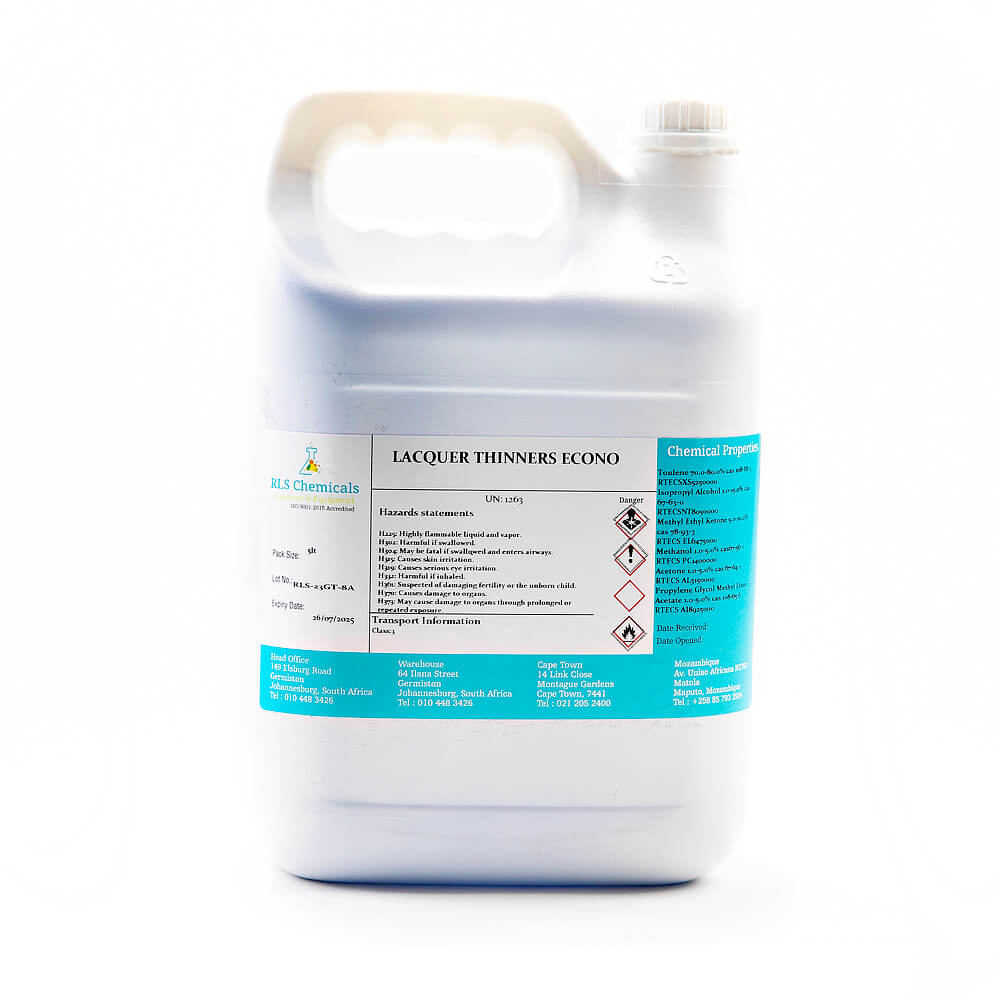
Product name: Lacquer Thinner Econo
CAS No: n/A
Synonyms: A Grade Thinners
1.2Intended Use of the Product
| SECTION 2: Lacquer Thinners Econo – HARZARDS IDENTIFICATION |
Flammable Liquids, Category 2
Acute Toxicity: Oral, Category 3
Acute Toxicity: Skin, Category 3
Acute Toxicity: Inhalation, Category 3
Serious Eye Damage/Eye Irritation, Category 2
Toxic To Reproduction, Category 2
Specific Target Organ Toxicity (single exposure), Category 1
Specific Target Organ Toxicity (repeated exposure), Category 2
Aspiration Toxicity, Category 1
GHS Signal Word: Danger
GHS Hazard Phrases: H225: Highly flammable liquid and vapor.
H301: Toxic if swallowed.
H304: May be fatal if swallowed and enters airways.
Lacquer Thinner Econo
H311: Toxic in contact with skin.
H319: Causes serious eye irritation.
H331: Toxic if inhaled.
H361: Suspected of damaging fertility or the unborn child.
H370: Causes damage to organs.
H373: May cause damage to organs through prolonged or repeated exposure.
P304+340: IF INHALED: Remove victim to fresh air and keep at rest in a position comfortable for breathing.
P305+351+338: IF IN EYES: Rinse cautiously with water for several minutes. Remove contact lenses, if present and easy to do. Continue rinsing.
P307+311: IF exposed: P311: Call a POISON CENTER or doctor/physician.
P308+313: IF exposed or concerned: Get medical attention/advice.
P314: Get medical attention/advice if you feel unwell.
P321: Specific treatment see label.
P330: Rinse mouth.
P331: Do NOT induce vomiting.
P337+313: If eye irritation persists, get medical advice/attention.
P363: Wash contaminated clothing before reuse.
P370+378: In case of fire, use dry chemical powder to extinguish.
GHS Storage and Disposal P403+233: Store container tightly closed in well-ventilated place. Phrases: P405: Store locked up.
P501: Dispose of contents/container according to local, state and federal regulations.
Lacquer Thinner Econo
| SECTION 3: COMPOSITION/ INFORMATION ON INGREDIENTS |
CAS # Hazardous Components (Chemical Name) Concentration
67-56-1 Methanol {Methyl alcohol; Carbinol; Wood 25.0 -35.0 %
alcohol}
67-64-1 Acetone {2-Propanone} 20.0 -30.0 %
NA Petroleum Hydrocarbon Mixture (Alkanes and 20.0 -30.0 %
Cycloalkanes)
141-78-6 Acetic acid, ethyl ester {Ethyl acetate} <15.0 %
108-88-3 Toluene {Benzene, Methyl-; Toluol} < 5.0 %
111-76-2 Ethanol, 2-Butoxy- {Ethylene glycol n-butyl ether, < 5.0 %
(a glycol ether)}
Additional Chemical Specific percentage of composition is being withheld as a trade secret. Information
| SECTION 4: Lacquer Thinners Econo – FIRST AID MEASURES |
4.1 Description of first aid measures
First-aid measures general: Never give anything by mouth to an unconscious person. If feeling unwell, seek medical advice (show the label where possible).
First-aid measures after inhalation: Remove victim to fresh air and keep at rest in a position comfortable breathing. Call a Poison Center or Physician if feeling unwell.
First-aid measures after skin contact: Remove contaminated clothing. Wash with plenty of water with soap. If skin irritation occurs: get medical attention.
First-aid measures after eye contact: Rinse with water for several minutes. Remove contact lenses, if present and easy to do. Continue rinsing. If eye irritation persists: get medical attention
First-aid measures after ingestion: Rinse mouth. DO NOT induce vomiting. Call Poison Center or Physician. Obtain emergency medical attention.
4.2 Most important symptoms and effects, both acute and delayed
Symptoms/injuries after inhalation: may Cause respiratory irritation.
Symptoms/injuries after skin contact: Causes skin irritation.
Symptoms/injuries after eye contact: Causes eye irritation.
Symptoms/injuries after ingestion: swallowing a small quantity of this material will result in serious health hazard.
| SECTION 5: FIRE-FIGHTING MEASURES |
NFPA Class IB
Flash Pt: < 15.00 F Method Used: Setaflash Closed Cup (Rapid Setaflash) Explosive Limits: LEL: 1 UEL: 7
Autoignition Pt: No data.
Suitable Extinguishing Media: Use carbon dioxide, dry powder, or foam.
Unsuitable Extinguishing Do not use a solid water stream, as this may spread the fire.
Media:
Lacquer Thinner Econo
Fire Fighting Instructions: Self-contained respiratory protection should be provided for fire fighters fighting fires in buildings or confined areas. Storage containers exposed to fire should be kept cool with water spray to prevent pressure build-up. Stay away from heads of containers that have been exposed to intense heat or flame.
Flammable Properties and No data available.
Hazards:
| SECTION 6: Lacquer Thinners Econo – ACCIDENTAL RELEASE MEASURES |
Steps To Be Taken In Case Vapors may cause flash fire or ignite explosively.
Material Is Released Or Spilled: Clean up: Keep unnecessary people away; isolate hazard area and deny entry. Stay upwind, out of low areas, and ventilate closed spaces before entering. Shut off ignition sources; keep flares, smoking or flames out of hazard area. Use non-sparking tools. Use proper bonding and grounding methods for all equipment and processes. Keep out of waterways and bodies of water. Be cautious of vapors collecting in small enclosed spaces, sewers, low lying areas, confined spaces, etc.
Small spills: Take up with sand, earth or other noncombustible absorbent material and place in a plastic container where applicable.
Large spills: Dike far ahead of spill for later disposal.
Waste Disposal: Dispose in accordance with applicable local, state and federal regulations.
| SECTION 7: HANDLING AND STORAGE |
Precautions To Be Taken: Do not use in small enclosed spaces, such as basements and bathrooms. Vapors can Handling: accumulate and explode if ignited.
Read carefully all cautions and directions on product label before use. Since empty container retains residue, follow all label warnings even after container is empty. Dispose of empty container according to all regulations. Do not reuse this container.
Do not use this product near any source of heat or open flame, furnace areas, pilot lights, stoves, etc.
Do not use in small enclosed spaces, such as basements and bathrooms. Vapors can accumulate and explode if ignited. Do not spread this product over large surface areas because fire and health safety risks will increase dramatically. Precautions To Be Taken in Keep container tightly closed when not in use. Store in a cool, dry place. Do not store Storing: near flames or at elevated temperatures.
| SECTION 8: EXPOSURE CONTROLS/PERSONAL PROTECTION |
CAS # Partial Chemical Name OSHA TWA ACGIH TWA Other Limits
67-56-1 Methanol {Methyl alcohol; Carbinol; PEL: 200 ppm TLV: 200 ppm No data. Wood alcohol} STEL: 250 ppm
67-64-1 Acetone {2-Propanone} PEL: 1000 ppm TLV: 500 ppm No data. STEL: 750 ppm
Lacquer Thinner Econo
NA Petroleum Hydrocarbon Mixture No data. TLV: 1500 mg/m3 No data. (Alkanes and Cycloalkanes)
141-78-6 Acetic acid, ethyl ester {Ethyl acetate} PEL: 400 ppm TLV: 400 ppm No data. 108-88-3 Toluene {Benzene, Methyl-; Toluol} PEL: 200 ppm TLV: 50 ppm No data. STEL: 500 ppm/(10min)
CEIL: 300 ppm
111-76-2 Ethanol, 2-Butoxy- {Ethylene glycol PEL: 50 ppm TLV: 20 ppm No data. n-butyl ether, (a glycol ether)}
Respiratory Equipment For OSHA controlled work place and other regular users. Use only with adequate (Specify Type): ventilation under engineered air control systems designed to prevent exceeding appropriate TLV.
For occasional use, where engineered air control is not feasible, use properly maintained and properly fitted NIOSH approved respirator for organic solvent vapors. A dust mask does not provide protection against vapors.
Eye Protection: Protect eyes with chemical splash goggles.
Protective Gloves: Wear gloves with as much resistance to the chemical ingredients as possible. Glove materials such as nitrile rubber may provide protection. Glove selection should be based on chemicals being used and conditions of use. Consult your glove supplier for additional information. Gloves contaminated with product should be discarded and not reused.
such as impermeable aprons, etc., to minimize exposure.
Engineering Controls Use only with adequate ventilation to prevent build-up of vapors. Open all windows and (Ventilation etc.): doors. Use only with a cross ventilation of moving fresh air across the work area. If
strong odor is noticed or you experience slight dizziness, headache, nausea, or eye-watering – Stop – ventilation is inadequate. Leave area immediately.
Do not use in small enclosed spaces, such as basements and bathrooms.
Work/Hygienic/Maintenance A source of clean water should be available in the work area for flushing eyes and skin. Practices: Do not eat, drink, or smoke in the work area.
Wash hands thoroughly after use.
Before reuse, thoroughly clean any clothing or protective equipment that has been
contaminated by prior use.
Discard any clothing or other protective equipment that cannot be decontaminated, such
as gloves or shoes.
| SECTION 9: Lacquer Thinners Econo – PHYSICAL AND CHEMICAL PROPERTIES |
Lacquer Thinner Econo
Physical States: [ ] Gas [ X ] Liquid
Appearance and Odor: Water White / Free and Clear
Melting Point: No data.
Boiling Point: 133.00 F
Autoignition Pt: No data.
Flash Pt: < 15.00 F Method Used:
Explosive Limits: LEL: 1
Specific Gravity (Water = 1): 0.7742 – 0.7942
Density: 6.518 LB/GL
Vapor Pressure (vs. Air or 115 MM HG at
mm Hg):
Vapor Density (vs. Air = 1): > 1
Evaporation Rate: > 1
Solubility in Water: Slight
Viscosity: Water thin
Percent Volatile: 100.0 % by weight.
VOC / Volume: 600.0000 G/L
| SECTION 10: STABILITY AND REACTIVITY |
10.1. Reactivity
No additional information available.
10.2. Chemical stability
Stable under normal conditions.
10.3. Possibility of hazardous reactions
Not established
10.5. incompatible materials
Strong oxidizers.
10.6. Hazardous decomposition products
Nitrogen oxides. Carbon monoxide. Carbon dioxide.
| SECTION 11: Lacquer Thinners Econo – TOXICOLOGICAL INFORMATION |
Toxicological Information: This product has not been tested as a whole. Information below will be for individual ingredients. Refer to section 2 for acute and chronic effects.
CAS# 67-64-1:
Standard Draize Test, Eyes, Species: Rabbit, 20.00 MG, Severe.
Result:
Behavioral: Change in motor activity (specific assay).
Behavioral: Alteration of classical conditioning.
Lacquer Thinner Econo
– American Journal of Ophthalmology., Ophthalmic Pub. Co., 435 N. Michigan Ave., Suite 1415, Chicago, IL 60611, Vol/p/yr: 29,1363, 1946
CAS# 141-78-6:
Standard Draize Test, Eyes, Human, 400.0 PPM.
Result:
Liver: Hepatitis (hepatocellular necrosis), zonal.
– Journal of Industrial Hygiene and Toxicology, Vol/p/yr: 25,282, 1943
CAS# 108-88-3:
Reproductive Effects:, TCLo, Inhalation, Rat, 800.0 MG/M3, 6 H, female 14-20 day(s)
after conception.
Result:
Effects on Embryo or Fetus: Fetotoxicity (except death, e.g., stunted fetus).
Effects on Newborn: Behavioral.
– Brazilian Journal of Medical and Biological Research., Vol/p/yr: 23,533, 1990
Standard Draize Test, Eyes, Species: Rabbit, 2.000 MG, 24 H, Severe.
Result:
Effects on Embryo or Fetus: Other effects to embryo.
Specific Developmental Abnormalities: Eye, ear.
– Prehled Prumyslove Toxikologie, Marhold, J., Organicke Latky, Prague Czechoslovakia, Vol/p/yr: -,29, 1986
CAS# 111-76-2:
Acute toxicity, LC50, Inhalation, Rat, 450.0 PPM, 4 H.
Result:
Behavioral: Ataxia.
Nutritional and Gross Metabolic:Weight loss or decreased weight gain.
Lacquer Thinner Econo
– Toxicology and Applied Pharmacology, Academic Press, Inc., 1 E. First St., Duluth, MN 55802, Vol/p/yr: 68,405, 1983
Acute toxicity, LD50, Skin, Species: Rabbit, 220.0 MG/KG.
Result:
Effects on Embryo or Fetus: Extra embryonic structures (e.g., placenta, umbilical cord).
Effects on Embryo or Fetus: Other effects to embryo.
Specific Developmental Abnormalities: Musculoskeletal system.
– Dow Chemical Company Reports., Dow Chemical USA, Health and Environment Research, Toxicology Research Lab, Midland, MI 48640, Vol/p/yr: MSD-46,
Carcinogenicity/Other IARC 3: Not Classifiable as to Carcinogenicity in Humans
Information: ACGIH A3 – Confirmed Animal Carcinogen with Unknown Relevance to Humans
ACGIH A4 – Not Classifiable as a Human Carcinogen
CAS # Hazardous Components (Chemical Name) NTP IARC ACGIH OSHA 67-56-1 Methanol {Methyl alcohol; Carbinol; Wood alcohol} n.a. n.a. n.a. n.a. 67-64-1 Acetone {2-Propanone} n.a. n.a. A4 n.a. NA Petroleum Hydrocarbon Mixture (Alkanes and n.a. n.a. n.a. n.a. Cycloalkanes)
141-78-6 Acetic acid, ethyl ester {Ethyl acetate} n.a. n.a. n.a. n.a. 108-88-3 Toluene {Benzene, Methyl-; Toluol} n.a. 3 A4 n.a. 111-76-2 Ethanol, 2-Butoxy- {Ethylene glycol n-butyl ether, (a glycol n.a. 3 A3 n.a. ether)}
| SECTION 12: Lacquer Thinners Econo – ECOLOGICAL INFORMATION |
Lacquer Thinner Econo
12.1 Other adverse effects
Other information: Avoid release to the environment.
| SECTION 13: DISPOSAL CONSIDERATIONS |
13.1. Waste treatment methods
Waste disposal recommendations: dispose of contents in accordance with the local, regional, national and international regulations.
Ecology: Avoid release to the environment.
| SECTION 14: TRANSPORT INFORMATION |
LAND TRANSPORT (US DOT):
DOT Proper Shipping Name: Paint Related Material
DOT Hazard Class: 3 FLAMMABLE LIQUID
UN/NA Number: UN1263 Packing Group: II
EPA SARA (Superfund Amendments and Reauthorization Act of 1986) Lists
CAS # Hazardous Components (Chemical Name) S. 302 (EHS) S. 304 RQ S. 313 (TRI) 67-56-1 Methanol {Methyl alcohol; Carbinol; Wood No Yes 5000 LB Yes alcohol}
67-64-1 Acetone {2-Propanone} No Yes 5000 LB No NA Petroleum Hydrocarbon Mixture (Alkanes and No No No Cycloalkanes)
141-78-6 Acetic acid, ethyl ester {Ethyl acetate} No Yes 5000 LB No 108-88-3 Toluene {Benzene, Methyl-; Toluol} No Yes 1000 LB Yes
111-76-2 Ethanol, 2-Butoxy- {Ethylene glycol n-butyl ether, No No Yes-Cat. N230 (a glycol ether)}
This material meets the EPA [X] Yes [ ] No Acute (immediate) Health Hazard
‘Hazard Categories’ defined [X] Yes [ ] No Chronic (delayed) Health Hazard
for SARA Title III Sections [X] Yes [ ] No Fire Hazard
311/312 as indicated: [ ] Yes [X] No Sudden Release of Pressure Hazard
[ ] Yes [X] No Reactive HazardCAS # Hazardous Components (Chemical Name) Other US EPA or State Lists 67-56-1 Methanol {Methyl alcohol; Carbinol; Wood CAA HAP,ODC: HAP; CWA NPDES: No; TSCA: Yes – alcohol} Inventory; CA PROP.65: Yes: RDTox.
67-64-1 Acetone {2-Propanone} CAA HAP,ODC: No; CWA NPDES: No; TSCA: Yes –
Lacquer Thinner Econo
Inventory; CA PROP.65: No
NA Petroleum Hydrocarbon Mixture (Alkanes and CAA HAP,ODC: No; CWA NPDES: No; TSCA: No; CA Cycloalkanes) PROP.65: Yes
141-78-6 Acetic acid, ethyl ester {Ethyl acetate} CAA HAP,ODC: No; CWA NPDES: No; TSCA: Yes – Inventory; CA PROP.65: No
108-88-3 Toluene {Benzene, Methyl-; Toluol} CAA HAP,ODC: HAP; CWA NPDES: Yes; TSCA: Yes – Inventory, 8A CAIR; CA PROP.65: Yes: RDTox(F)
111-76-2 Ethanol, 2-Butoxy- {Ethylene glycol n-butyl ether, CAA HAP,ODC: Yes – Cat.; CWA NPDES: No; TSCA: Yes – (a glycol ether)} Inventory; CA PROP.65: No
Regulatory Information: This product is regulated by the United States Consumer Product Safety Commission and is subject to certain labeling requirements under the Federal Hazardous Substances
Act. These requirements differ from the classification criteria and hazard information
required for safety data sheets (SDS). The product label also includes other important
information, including directions for use, and should always be read in its entirety prior to
using the product.
Additional Transport The shipper/supplier may apply one of the following exceptions: Combustible Liquid, Information: Consumer Commodity, Limited Quantity, Viscous Liquid, Does Not Sustain Combustion,
or others, as allowed under 49CFR Hazmat Regulations. Please consult 49CFR Subchapter C to ensure that subsequent shipments comply with these exceptions.
| SECTION 15: Lacquer Thinners Econo – REGULATORY INFORMATION |
| SECTION 16: OTHER INFORMATION |
Revision date : 27/02/2019
Other information : None
DisclaimerThe information stated above is considered to be correct, but does not claim to be inclusive and shall only be used as a guideline. The information provided by this document is confirmed by our continuous updating of knowledge and adheres to the products appropriate safety precautions. It does not represent any guarantee of the product’s
properties. RLS Chemicals and its Associates shall not be held accountable for any damage’s consequent of handling the above product.
Add to Wishlist
Add to Wishlist
Related products
Bulk Chemicals
Bulk Chemicals
Bulk Chemicals
Bulk Chemicals
Bulk Chemicals
Bulk Chemicals
Bulk Chemicals
Bulk Chemicals